'Tech Highlight': Organoid Intelligence – A Revolutionary Computing Frontier
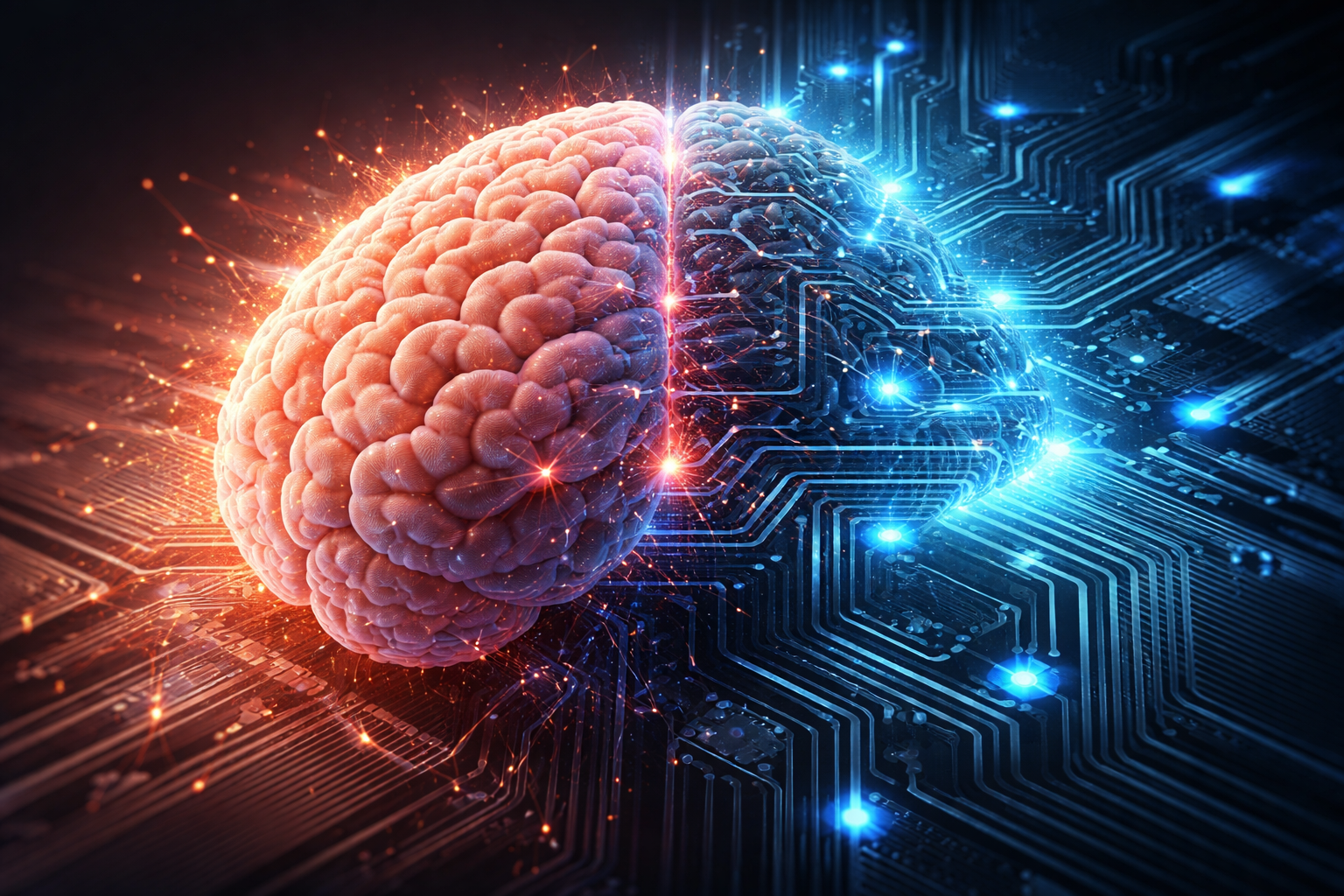
Organoid intelligence (OI) represents a bold new direction in computing. One that blends biology with information technology to potentially surpass the limits of silicon‑based systems. At its core, OI seeks to harness the natural processing power of human neural tissue, specifically three‑dimensional (3D) brain organoids, as living processors or biological co‑processors in future computers.
Conventional computers and modern machine‑learning models have achieved remarkable feats, yet they’re reaching physical and energy limitations. Traditional processors require vast amounts of electricity and struggle with tasks that human brains perform effortlessly, such as learning from sparse data and adapting to new contexts with minimal training. By contrast, biological neural networks excel at these tasks while consuming only a tiny fraction of the energy. For example, the human brain operates at around 10–20 watts yet outperforms many of our most powerful machines in flexibility and efficiency.
One of the most compelling promises of OI is energy efficiency. Current supercomputers and AI models can demand megawatts of power, whereas organoid‑based computing could theoretically operate with milliwatts, enabling ultra‑low‑energy edge devices, mobile applications, and next‑generation robotics that learn and adapt in real‑time without draining batteries.
Another breakthrough potential lies in data efficiency and learning capability. Unlike artificial neural networks that require millions of labelled examples to generalise reliably, biological neural systems can learn from very few instances; a phenomenon known as few‑shot learning. Brain organoids, with their innate neuroplasticity (the ability to rewire themselves), could continuously refine behaviour and responses to novel inputs, mirroring how living brains learn from incomplete or unstructured information.
OI also sidesteps a core bottleneck in traditional computing, called the Von Neumann architecture, where memory and processing are physically separated. In biological neural tissues, processing and memory storage occur simultaneously at synaptic connections, enabling massive parallel computing and reducing the overhead of shuttling data between units. This could lead to more efficient pattern recognition, real‑time adaptive algorithms, and resilient computing architectures capable of graceful degradation if parts are damaged.
In practice, the vision of organoid computing involves integrating living neural networks with electronic interfaces, sensors, and AI frameworks. These bio‑hybrid systems could serve as specialised co‑processors, handling context‑aware tasks such as pattern recognition, environmental adaptation, or sensor fusion, while traditional digital systems manage communications and reliability guarantees.
While still in early stages, OI could redefine what ‘computing’ means. By learning from the brain’s structure and dynamics, researchers hope to unlock entirely new paradigms of computation that are smarter, more efficient, and fundamentally different from today’s silicon‑centric world.
Source Link: How-can-organoid-intelligence-potentially-revolutionise-the-future-of-computing
The Tech Highlight is a new weekly feature, intended as a short, focused piece of content that showcases a specific technology, innovation, or emerging trend. If you have any cool stuff that you think would be interesting to this community please share!
To make sure you don’t miss it, please log into your account and update your notification preferences. Please share it, give feedback, and join the discussion - I hope you enjoy it!


Chief Editor
A career deeply rooted in drug discovery and a focus on digital transformation and innovation in drug discovery.