High-content toxicological profiling of 87 compounds using a 3D mouse mini-testis model: a New Approach Methodology (NAM) for prioritizing male reproductive toxicants

This integrated high-throughput and high-content analysis (HT/HCA) platform enables systematic profiling of reproductive toxicity signatures and establishes the 3D mini-testis model as a predictive, scalable, and animal-free NAMs for reproductive toxicology and chemical risk assessment.

Like

Share this post

Choose a social network to share with, or copy the URL to share elsewhere

This is a representation of how your post may appear on social media. The actual post will vary between social networks

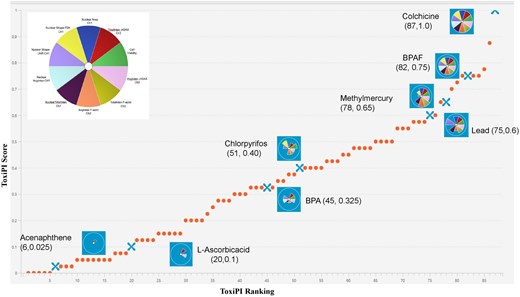
ToxPi-based ranking and visualization of 87 compounds screened using the 3D mini-testis high-content assay. Each compound was evaluated across 10 mechanistically relevant phenotypic endpoints, and the resulting PODs were integrated into Toxicological Priority Index (ToxPi) scores. The scatter plot shows compounds ranked along the x-axis by increasing ToxPi score, representing increasing toxicological concern. The y-axis indicates the normalized ToxPi score (range: 0 to 1). Highlighted compounds are labeled with their rank and ToxPi score (e.g. BPA: rank 45, score 0.325). Pie charts represent the individual ToxPi profiles of select reference compounds, with each of the 10 slices corresponding to a single phenotypic endpoint (e.g. cell viability, nuclear morphology, γH2AX, F-actin). The radial length of each slice is proportional to the relative toxicity of that endpoint; all endpoints were equally weighted. Key reference compounds include high-toxicity examples: Colchicine (rank 87, score 1.0), BPAF (rank 82, score 0.75), methylmercuric chloride (rank 78, score 0.65), and lead (rank 75, score 0.60). Low-toxicity examples: acenaphthene (rank 6, score 0.025), and L-ascorbic acid (rank 20, score 0.10).

Please sign in or register for FREE

If you are a registered user on WORC.Community, please sign in